
Table of Contents
Best banks in Ireland are a key consideration for anyone moving to Ireland, changing bank accounts or looking for better fees and digital services. Ireland’s banking sector has changed significantly in recent years, with traditional banks competing against digital providers and new entrants. Understanding account fees, online banking, savings rates and customer support can help you choose the right option for your needs.
Why choosing the right bank in Ireland matters
Banking is an essential part of daily life in Ireland. Your bank account affects how you receive wages, pay bills, access credit and save money.
The Irish banking market has evolved following the withdrawal of some banks from the market. Consumers now have fewer traditional banks but more digital alternatives.
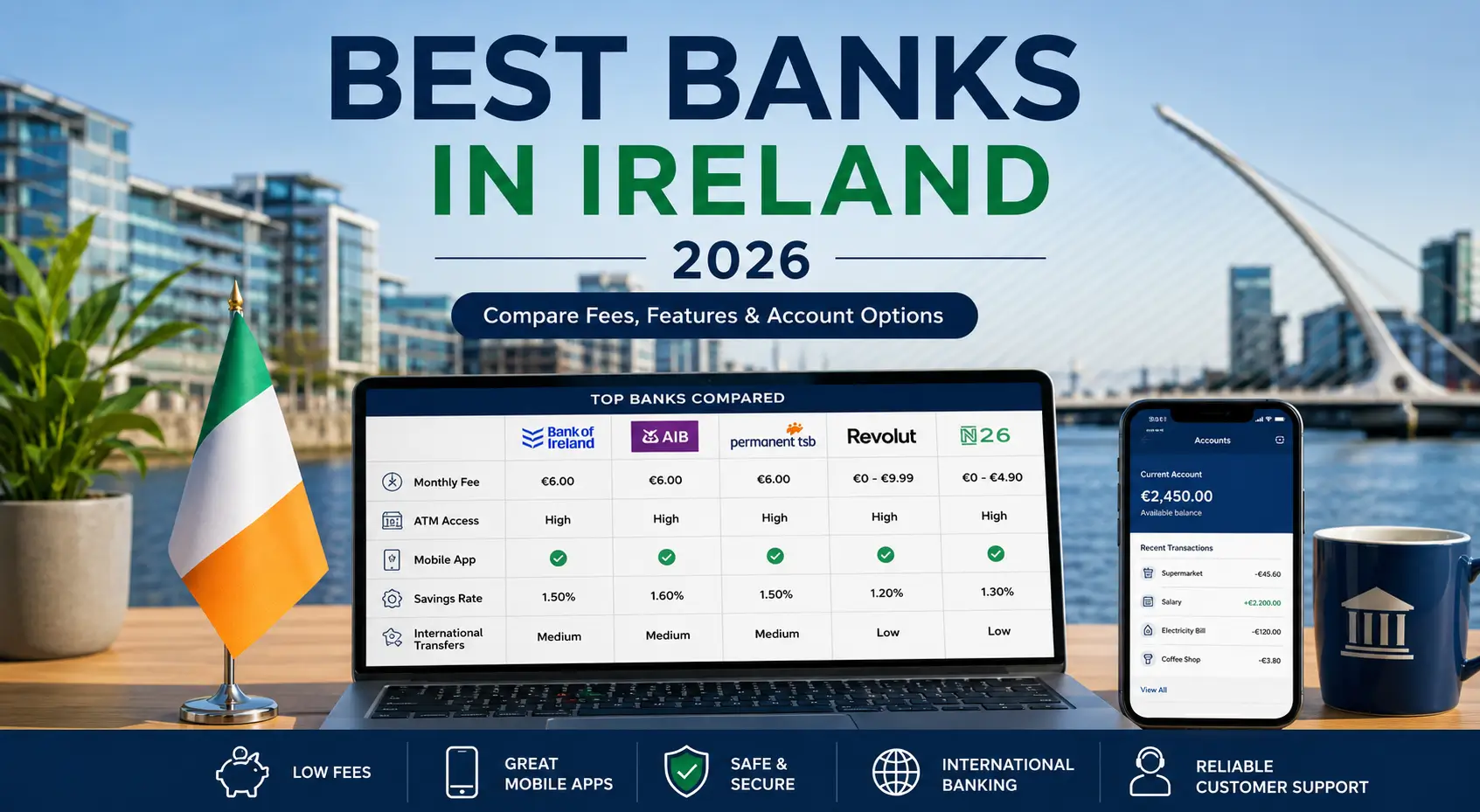
When comparing the Best banks in Ireland, consider:
- Monthly maintenance fees
- ATM access
- Mobile banking features
- Customer service availability
- Mortgage offerings
- Savings account rates
- Branch locations
- International transfer options
Choosing the wrong bank may result in unnecessary fees or limited services.
What makes the Best banks in Ireland in 2026?
The Best banks in Ireland differ depending on personal circumstances. A student may prioritise low fees, while a homeowner may value mortgage products.
Key factors to assess include:
- Ease of opening an account
- Availability of physical branches
- Mobile app quality
- Security features
- Foreign exchange costs
- Joint account options
- Customer satisfaction
Irish banks are regulated by the Central Bank of Ireland. Consumers can verify authorised institutions through Central Bank of Ireland.
Deposits are generally protected under the Deposit Guarantee Scheme up to applicable limits. Details can be found at Deposit Guarantee Scheme information.
Traditional banks versus digital banks in Ireland
Ireland offers both traditional and digital banking solutions.
Traditional banks provide:
- Branch networks
- Cash services
- Mortgage advice
- In-person customer support
Digital banks provide:
- App-based banking
- Faster notifications
- Lower international transfer costs
- Simplified account management
Many people use both a traditional and digital account to maximise convenience.
When reviewing the Best banks in Ireland, consider whether you require face-to-face banking or mainly use online services.
Best banks in Ireland for everyday banking
Several institutions dominate the Irish banking market in 2026.
Traditional leaders among the Best banks in Ireland
The main traditional banks include:
- Bank of Ireland
- AIB
- Permanent TSB
These banks offer:
- Current accounts
- Savings accounts
- Mortgages
- Loans
- Credit cards
They maintain branch networks across Ireland, which can be useful for customers requiring cash or in-person services.
Digital challengers changing Irish banking
Digital providers have become increasingly popular.
Examples include:
- Revolut
- N26
- Bunq
Benefits often include:
- Real-time spending alerts
- Budgeting tools
- Low-cost international transfers
- Easy account opening
However, some digital banks may have limited lending products in Ireland.
The Best banks in Ireland for digital users often depend on whether you require loans or mortgages.
Comparing fees charged by the Best banks in Ireland
Bank fees vary considerably.
Common charges include:
- Monthly account fees
- ATM charges
- Foreign transaction fees
- Card replacement fees
- Overdraft costs
Before opening an account, carefully review the bank’s schedule of charges.
Irish consumers can seek independent guidance from Competition and Consumer Protection Commission.
Common mistakes include:
- Ignoring transaction charges
- Overlooking foreign currency costs
- Choosing accounts with unnecessary features
The Best banks in Ireland are not always the cheapest. Value depends on the services you actually use.
Best banks in Ireland for newcomers and expats
Opening an Irish bank account can be challenging for new arrivals.
Typically required documents include:
- Passport or national ID
- Proof of address
- PPS Number, where applicable
Some banks accept alternative documentation for new residents.
Opening an account as a new resident
New residents should:
- Gather identification documents.
- Obtain proof of address.
- Apply online or in branch.
- Verify identity if requested.
- Activate debit cards and online banking.
Many newcomers find that digital banks are easier to open initially while waiting for permanent address documentation.
For people relocating permanently, the Best banks in Ireland usually combine easy account opening with long-term products such as mortgages.
Internal linking suggestion: Readers may also find your guide on obtaining a PPS Number in Ireland useful before opening an account.
Savings accounts and interest rates in Ireland
Savings rates in Ireland have improved in recent years, although they may still differ significantly between institutions.
Important factors include:
- Instant access availability
- Notice periods
- Fixed-term deposits
- Interest rates
- Deposit protection
Consumers should regularly compare rates as they can change.
The Best banks in Ireland for savers are not always the same as the best providers for daily banking.
When evaluating savings products:
- Check whether interest is variable or fixed.
- Confirm withdrawal restrictions.
- Review tax implications.
Interest earned may be subject to Deposit Interest Retention Tax. Further information is available from the Revenue Commissioners.
H2: Which bank is best for mortgages and loans?
For many households, lending products are more important than current accounts.
Mortgage considerations include:
- Interest rates
- Fixed or variable options
- Loan-to-value ratios
- Approval times
- Customer service
Personal loan factors include:
- APR
- Repayment flexibility
- Early repayment conditions
The Central Bank of Ireland sets mortgage lending rules that lenders must follow. Guidance is available at https://howtoireland.com/mortgage-approval-process-ireland/.
The Best banks in Ireland for mortgages may differ depending on your income, deposit size and employment status.
Internal linking suggestion: Consider linking to a guide on first-time buyer grants in Ireland.
Mobile banking and technology features
Modern banking increasingly depends on digital services.
Features to look for include:
- Instant notifications
- Spending analytics
- Virtual cards
- Card freezing tools
- Apple Pay and Google Pay support
- Multi-currency accounts
Security is particularly important.
Customers should:
- Enable two-factor authentication
- Use strong passwords
- Monitor transactions regularly
- Report suspicious activity immediately
The National Cyber Security Centre offers guidance on staying secure online through National Cyber Security Centre Ireland.
Many consumers rank app quality highly when comparing the Best banks in Ireland.
Are online-only banks safe in Ireland?
Many people wonder whether digital banks are secure.
Generally, safety depends on:
- Regulatory oversight
- Deposit protection
- Security systems
- Fraud prevention measures
Always confirm whether a bank is authorised in the European Economic Area and whether deposit protection applies.
Consumers should verify institutions through the official register maintained by the Central Bank of Ireland.
The Best banks in Ireland include both traditional and digital providers, provided they operate under proper regulatory frameworks.
Common warning signs include:
- Unsolicited banking offers
- Requests for passwords
- Unusual payment instructions
- Suspicious links
Never share banking security codes with anyone.
How to choose among the Best banks in Ireland
Choosing the right bank depends on your circumstances.
Students may prioritise:
- Low fees
- Mobile banking
- Free transactions
Families may prioritise:
- Mortgages
- Joint accounts
- Branch access
Business owners may prioritise:
- Merchant services
- Business accounts
- International payments
Workers paid from abroad may prioritise:
- Currency exchange
- International transfers
- Multi-currency accounts
When assessing the Best banks in Ireland, create a checklist of your most important requirements before applying.
Practical example:
A new employee in Dublin may choose a traditional bank for salary payments while using a digital bank for travel spending. This hybrid approach is increasingly common.
Internal linking suggestion: Link to an article explaining how to transfer money internationally from Ireland.
Common banking mistakes to avoid in Ireland
Consumers often make avoidable banking errors.
Common mistakes include:
- Failing to compare fees
- Ignoring savings rates
- Choosing based solely on advertising
- Not reviewing account terms
- Keeping unused accounts open
Another mistake is failing to update contact details, which can lead to missed security alerts.
The Best banks in Ireland may change over time as products and fees evolve, so review your banking arrangements regularly.
Before switching banks:
- Download statements
- Update direct debits
- Inform employers
- Transfer regular payments
- Monitor both accounts during transition
The Competition and Consumer Protection Commission provides useful information on switching accounts.
Banking regulations and consumer protection in Ireland
Ireland has strong consumer protections for banking customers.
Relevant authorities include:
- Central Bank of Ireland
- Competition and Consumer Protection Commission
- Financial Services and Pensions Ombudsman
Consumers with complaints should first contact their bank. If unresolved, complaints may be escalated to the Financial Services and Pensions Ombudsman through Financial Services and Pensions Ombudsman.
Regulations can change over time. Always verify current rules with the relevant authority.
The Best banks in Ireland should offer transparency, fair treatment and strong customer support.
Conclusion
Choosing among the Best banks in Ireland requires balancing fees, digital features, branch access, savings products and lending options. There is no single solution for everyone. Traditional banks remain important for mortgages and in-person services, while digital providers offer convenience and low-cost international features. Review your financial needs regularly and compare providers before making a decision. For most residents and newcomers, researching the Best banks in Ireland carefully can save money and improve day-to-day financial management.
Frequently Asked Questions
Q: What are the Best banks in Ireland for everyday use?
A: The Best banks in Ireland for everyday use often include traditional providers such as AIB, Bank of Ireland and Permanent TSB, alongside digital banks like Revolut and N26.
Q: Can foreigners open a bank account in Ireland?
A: Yes. Most banks allow non-Irish residents to open accounts if they provide valid identification and proof of address.
Q: Are online banks regulated in Ireland?
A: Many online banks operate under European regulations and may provide deposit protection, depending on their licensing arrangements.
Q: Which of the Best banks in Ireland offer mortgages?
A: Traditional banks such as AIB, Bank of Ireland and Permanent TSB are major mortgage providers in Ireland.
Q: Is my money protected in an Irish bank?
A: Eligible deposits are generally protected up to applicable limits under the Deposit Guarantee Scheme.
Q: How can I compare bank fees in Ireland?
A: Compare account charges, transaction fees, foreign exchange costs and additional services before opening an account.
Q: Can I switch banks easily in Ireland?
A: Yes. Banks offer switching services, but you should carefully transfer direct debits and standing orders.
Last updated: June, 2026
