
Last updated: July 2026
Table of Contents
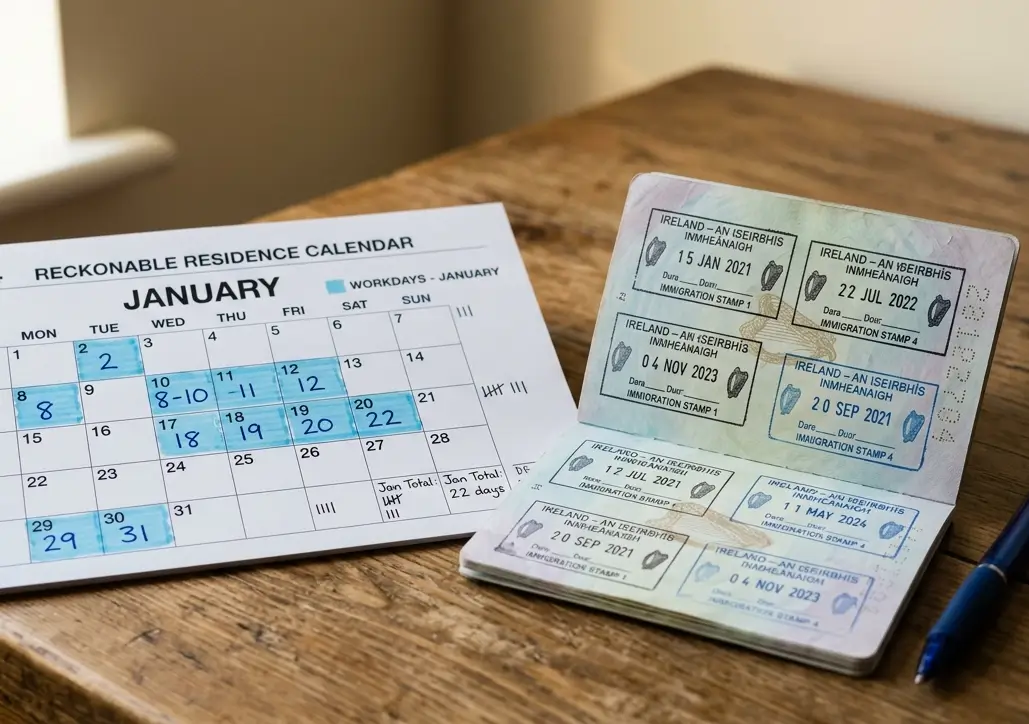
The Department of Justice calls this “reckonable residence,” but it just means qualifying residence: the time you’ve spent in Ireland that actually counts towards citizenship. You need 5 years of it within the last 9 years: 1 continuous year immediately before you apply, plus 4 more years within the 8 years before that. Time on a student permission or awaiting an asylum decision doesn’t count, and absences over 70 days in your final year can break continuity.
The Core Rule
To qualify for naturalisation by residence, you need to show:
- 1 year of continuous qualifying residence immediately before the date you apply, and
- 4 further years of qualifying residence within the 8 years before that
That’s 5 years out of the last 9, but it’s not simply “any 5 years.” The most recent year has to be unbroken, which is where most people trip up.
What Counts and What Doesn’t
| Counts towards qualifying residence | Doesn’t count |
|---|---|
| Employment permit residence (Stamp 1) | Student permission (Stamp 2 or 2A), unless applying as a ‘young adult’ |
| Stamp 4 residence | Time spent waiting for an asylum or international protection decision |
| Stamp 5 (Without Condition as to Time) | |
| Time as spouse/partner of a Critical Skills or General Employment Permit holder | |
| Time on Stamp 1G (Third Level Graduate Scheme) | |
| Residence after a positive refugee or stateless person decision |
This is the single biggest reason people miscalculate their own timeline: years spent here on a student stamp don’t count at all, even though you were legally resident. If you did a master’s degree on a Stamp 2 before switching to a work permit, that student time simply doesn’t go on the clock.
The Absence Rule (and a Common Mistake)
You’re allowed to be outside Ireland for up to 70 days in the year of continuous residence immediately before you apply, without it breaking your continuity. The day you leave and the day you return don’t count as absence days. A further 30 days may be allowed for exceptional circumstances like health, family or work, if you explain it in your application.
Common mistake: A lot of older blogs and forum posts still quote a “six-week rule” (42 days). That limit was replaced with the current 70-day allowance when the law changed in August 2023. If you’re reading advice that mentions six weeks, it’s out of date.
Three Worked Examples
Example 1: Straightforward employment history. Esha arrived in 2020 on a Critical Skills Employment Permit (Stamp 1), stayed on the same or equivalent permission continuously, and applies in 2026. All 6 years count. She easily clears both the 1-year continuous requirement and the 4-year requirement, well past the 5-in-9 minimum.
Example 2: Student time that doesn’t count. Tomas arrived in 2018 on a Stamp 2 student visa, finished his course in 2021, and switched to a Stamp 1 work permit that year. Even though he’s been in Ireland since 2018, his qualifying residence clock effectively starts in 2021, when his student time stopped. By 2026 he has 5 years of qualifying residence, not 8, and needs to check the exact switch date carefully.
Example 3: A long trip home mid-way. Fatima has had a Stamp 4 since 2019. In late 2025, planning her 2026 application, she spent 11 weeks (77 days) back in her home country for a family matter. That’s over the 70-day limit for her final continuous year, so unless it qualifies under the 30-day exceptional circumstances allowance, her continuous-residence year restarts from her return date, and she’ll need to wait before applying.
Spouses and Civil Partners: A Shorter Route
If you’re married to, or in a civil partnership with, an Irish citizen, the residence requirement drops to 3 years of qualifying residence on the island of Ireland, alongside 3 years of marriage or civil partnership. Residence in Northern Ireland counts towards this route, which it doesn’t for the standard 5-in-9 calculation.
How to Check Your Own Position
- Use the free official calculator. The Immigration Service Delivery runs a Naturalisation Residency Calculator that counts backwards from your intended application date and tells you whether you meet the requirement. It’s still officially labelled “reckonable residence,” so you’ll see that exact term when you use it.
- Gather your permission history first, not your application. Pull together every IRP card and permission letter before you try to count anything.
- Check your start date carefully if you’ve had more than one stamp type. The calculator only helps if you enter accurate dates for each permission.
- Don’t apply before you’re sure. Applying too early gets you refused, and the €175 application fee isn’t refunded.
Common Mistakes to Avoid
- Assuming every year physically spent in Ireland counts, including student years
- Forgetting that the final year has to be continuous, not just any year within the 9
- Using the outdated 42-day absence limit instead of the current 70 days
- Applying before checking the free official calculator first
Frequently Asked Questions
Does time on a student visa count towards Irish citizenship?
No, not for the standard route. Time spent on a Stamp 2 or Stamp 2A student permission doesn’t count as qualifying residence, unless you’re applying under the specific ‘young adult’ provision.
How many days can I be outside Ireland before applying?
Up to 70 days in the year of continuous residence immediately before your application, not counting your day of departure or return. A further 30 days may be allowed for exceptional circumstances if you explain them in your application.
Does time spent waiting for an asylum decision count?
No. Time spent waiting for a decision on an international protection application doesn’t count as qualifying residence. It only starts counting once you receive a positive decision.
What to Do Now
- Pull together your full immigration permission history, with exact start and end dates for each stamp.
- Run your dates through the official Naturalisation Residency Calculator before you do anything else.
- If your history includes student time, a refugee decision, or a long absence, double check against the rules above rather than assuming.
Once you’ve confirmed you qualify, our guide to naturalisation application fees covers what you’ll actually pay, and our PPS number guide is a good starting point if you’re still building your document history.
This is general information, not immigration advice. For a borderline or complicated residency history, it’s worth getting advice from an immigration solicitor before you apply.
