
Last updated: July 2026
Table of Contents
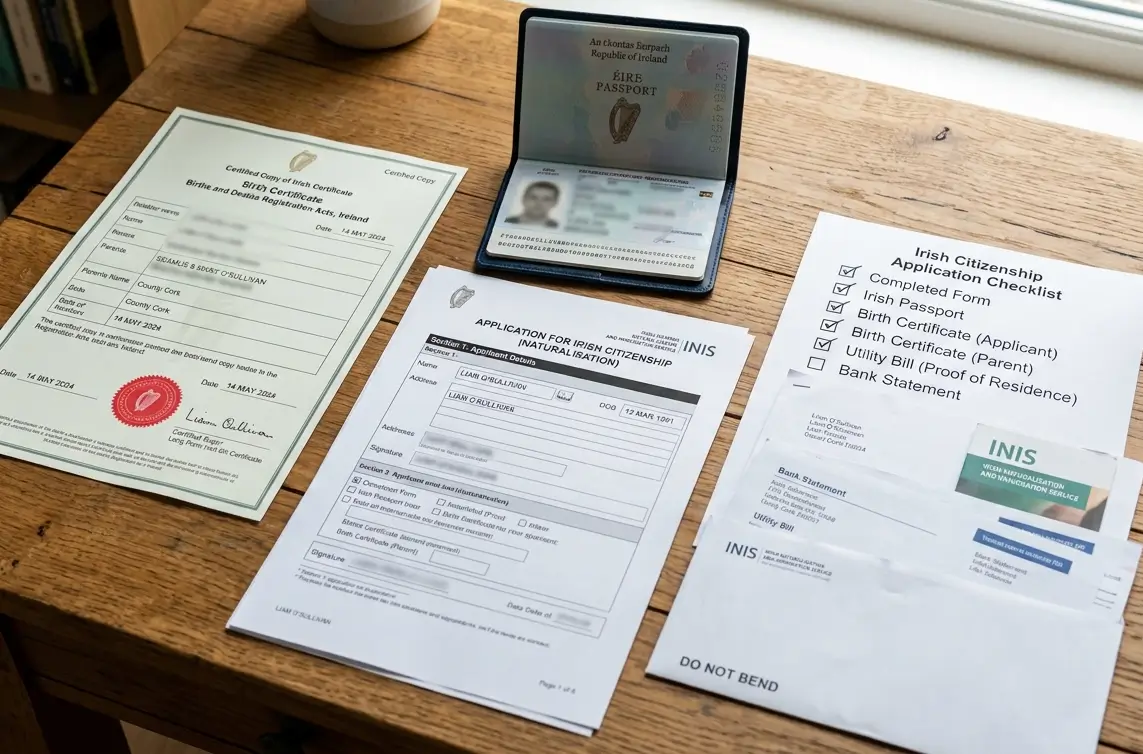
Every naturalisation application needs proof of identity, a certified birth certificate, two signed photos, an Irish Residence Permit copy and a signed Statutory Declaration, plus proof of residence that scores 150 points for every year claimed. What else you need depends on your route: standard residence, marriage, refugee status, or Irish associations.
The 150-Point System, Explained
Since 2022, Immigration Service Delivery (ISD) assesses your identity and residence evidence using a scorecard rather than a fixed list of required documents. Every document you can submit is worth a set number of points, and you need to reach 150 points for identity (once, not per year) and 150 points for residence in each year you’re claiming.
The Immigration Service Delivery’s own guidance is clear on a few things people get wrong:
- A certified colour copy of your valid, in-date home country passport biometric page is worth the full 150 points on its own, covering the entire identity requirement in one document.
- You only need to prove your identity once, not for every year you’ve lived here.
- Once you’ve reached 150 points for a given year, stop. Sending more documents doesn’t strengthen your application, and the Department will contact you if it needs more.
Pro tip: Since 1 January 2022, you no longer need to send your original passport. A certified colour copy of the biometric page, witnessed by a solicitor, Commissioner for Oaths, Peace Commissioner or Notary Public, is enough.
Documents Every Applicant Needs
- Completed Form 8 (Form 8A if a minor is being naturalised alongside a parent).
- The €175 application fee, which is non-refundable regardless of the outcome.
- Proof of identity worth 150 points, usually one certified colour copy of your passport’s biometric page.
- A certified copy of your original civil birth certificate, with a certified English translation if it isn’t in English or Irish.
- Two colour passport photographs, taken within 30 days of your application, signed and dated on the back by whoever witnesses your Statutory Declaration.
- A copy of your current Irish Residence Permit (not required for EU/EEA citizens).
- Proof of residence worth 150 points for every year of residence claimed (see below).
- A signed Statutory Declaration, witnessed in person by a solicitor, Commissioner for Oaths, Peace Commissioner or Notary Public.
Proof of Residence: What Actually Counts
The Department’s own examples of accepted residence proof include:
- Household utility bills: gas, electricity, water, home phone, bin collection, TV licence, cable or satellite subscriptions
- An Employment Detail Summary, which must be in your own name, not a spouse’s or partner’s
- A Department of Social Protection Contribution Statement, showing your social insurance contributions or claims
- Letters from the Residential Tenancies Board, or a hospital appointment letter
- Official government correspondence about local property tax or social welfare payments
- Bank statements, provided they show at least three consecutive monthly transactions per year and are issued by a bank or credit union regulated by the Central Bank of Ireland or the European Central Bank
Common mistake: Child Benefit payment statements are not accepted as proof of a child’s residence. You’ll need something else, such as a school attendance report, for a child’s application.
Extra Documents by Route
Your standard document set above covers most applicants, but your specific route adds a few more requirements.
Applying Through Marriage or Civil Partnership
- A certified copy of your marriage certificate or civil partnership registration
- Documentary proof your Irish spouse or civil partner is entitled to Irish citizenship: their Irish birth certificate, passport, naturalisation certificate, or Foreign Births Register entry
- Evidence of your 3 years of qualifying residence and 3 years of marriage or civil partnership
If the civil partnership was registered outside Ireland, check that it’s recognised under the Civil Partnership (Recognition of Registered Foreign Relationships) Order 2010 before applying on this basis.
Applying as a Refugee or Stateless Person
- A copy of the letter confirming your refugee or stateless person status
- Your original passport and any other identity document you hold
- Your original Travel Document, if you have one
Applying Through Irish Associations
- Certified copies of documentation proving your Irish associations: birth or marriage certificates, a Foreign Births Register entry, a naturalisation certificate, or a certified passport copy of the Irish relative you’re basing your application on
Minors Naturalised With a Parent
Children being naturalised alongside a parent use Form 8A, not Form 8, and the document set is different. This deserves its own dedicated guide rather than a quick summary here.
Certification and Translation Rules
Documents that need to be certified as “true copies” must be certified by a solicitor, Notary Public, Commissioner for Oaths, or Peace Commissioner. The same person can usually witness your Statutory Declaration and certify your documents in the same appointment.
Any document not already in English or Irish, most commonly a birth certificate, needs a certified English translation attached alongside the certified copy of the original.
Good Character Disclosure
You’re required to be of good character, and this isn’t limited to serious convictions. Immigration solicitors routinely advise disclosing minor issues too, including fixed penalty notices or points on a driving licence, even where they never went to court. Disclosure is normally made by cover letter or an additional page attached to your application, rather than a separate form.
Warning: Providing false or misleading information anywhere in your application is a criminal offence under Section 29A of the Irish Nationality and Citizenship Act 1956, carrying penalties of up to €50,000 and up to 5 years’ imprisonment. Passports and other documents are checked for fraud as standard.
Common Mistakes to Avoid
- Assuming more documents automatically means a stronger application, past the 150-point threshold
- Submitting a household bill in a spouse’s name only, when it needs to be in the applicant’s own name
- Forgetting the certified English translation on a birth certificate that isn’t in English or Irish
- Sending an original passport when a certified colour copy is all that’s required
- Leaving out minor disclosures (fixed penalty notices, old convictions) because they seem too small to matter
Frequently Asked Questions
How many points do I need for my Irish citizenship application?
150 points for identity, proved once, and 150 points for residence for each year of residence you’re claiming. A single certified passport copy can cover the entire identity requirement on its own.
Do I need to send my original passport?
No. Since 1 January 2022, a certified colour copy of your passport’s biometric page, witnessed by a solicitor or equivalent, replaces the need to send the original.
What if I can’t get a certified translation of my birth certificate?
You’ll need a certified English translation regardless, since the Department can’t process documents in a language other than English or Irish. A certified or professional translator can provide this alongside the certified copy of the original.
Does a Child Benefit statement count as proof of my child’s residence?
No. It’s explicitly excluded. You’ll need separate evidence, such as a school attendance report, for a child’s residence claim.
What to Do Now
- Work out which route applies to you (standard residence, marriage, refugee status, or Irish associations), since it decides your extra document list.
- Gather your identity and residence documents against the 150-point rule above, rather than sending everything you have.
- Book a single appointment with a solicitor, Notary Public, Commissioner for Oaths or Peace Commissioner to certify your documents and witness your Statutory Declaration together.
Before you start gathering documents, it’s worth confirming you actually meet the residency requirement first. Our guide to calculating your reckonable residence for citizenship walks through the 5-in-9 rule with worked examples, so you’re not assembling paperwork for an application you’re not yet eligible to make.
This is general information, not immigration advice. For a complicated document history, or if you’re unsure whether something needs disclosing, get advice from an immigration solicitor before you apply.
